
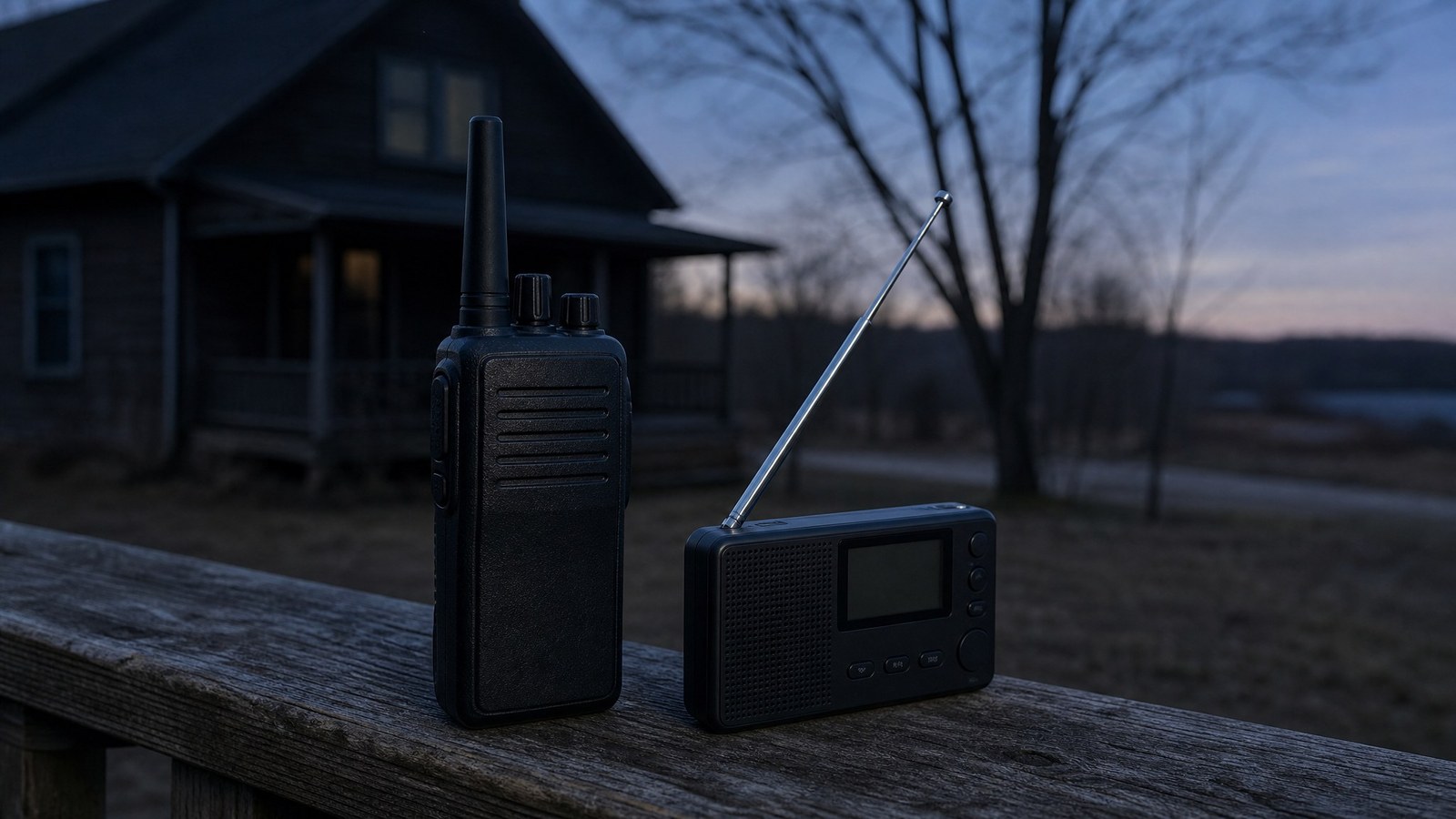
Understanding Grid-Down Communication Options
No single radio covers a grid-down event. Build it in layers: a way to receive official information, a short-range way to talk to your own people, and a written plan that says who checks in with whom and when. Two published numbers are worth anchoring your expectations to. NOAA Weather Radio service to a county depends on reception that, per the National Weather Service, typically extends about a 40 mile radius from the transmitter, assuming level terrain. And for licensed GMRS, the FCC's own stated expectation is a range of one to twenty-five miles depending on station class, terrain and repeater use. While you still have any cell service at all, the FCC says to reach 911 by voice call whenever you can.
"Grid down" gets used as a single phrase for a whole range of failures that behave nothing alike. The power going out on your street while every cell tower in the county keeps humming is one thing. A regional storm that knocks out power, floods the roads and leaves the surviving towers so congested that calls fail is another. Damage severe enough to take a chunk of the network off the air for days is a third. They ask different things of you.
The mistake worth avoiding is buying for the rarest version and ending up with nothing useful for the common one. Most outages are short, local and leave your phone working fine. So the sensible build starts with the boring case and adds capability outward from there, rather than starting with a shortwave fantasy and never getting around to writing down where the family meets.
What follows is the honest landscape: what each option actually is, what the agencies that regulate and operate them publish about their reach, and where each one stops being useful.
Receiving Beats Transmitting
The first capability to buy is not the ability to talk. It is the ability to hear something authoritative when your phone has nothing to show you. That is a weather radio, and it is a genuinely underrated piece of kit because the name undersells it.
NOAA Weather Radio All Hazards is a nationwide network of radio stations that broadcast continuous weather information directly from the nearest National Weather Service office, carrying official warnings, watches, forecasts and other hazard information 24 hours a day, seven days a week. The National Weather Service describes it as working with the FCC's Emergency Alert System, which makes it an all-hazards network rather than a weather-only one. In conjunction with federal, state and local emergency managers, it also carries warning and post-event information for natural hazards such as earthquakes or avalanches, environmental ones such as chemical releases or oil spills, and public safety ones such as AMBER alerts and 911 telephone outages.
Read that last item again. The network that can tell you 911 is unreachable in your area is not the phone network. That is the whole argument for owning one.
The practical details matter. NWR includes more than 1,000 transmitters covering all 50 states, adjacent coastal waters, Puerto Rico, the U.S. Virgin Islands and the U.S. Pacific Territories. It broadcasts in the VHF public service band on seven frequencies: 162.400, 162.425, 162.450, 162.475, 162.500, 162.525 and 162.550 MHz. And it requires a special radio receiver or scanner capable of picking up the signal. The broadcasts sit in the VHF public service band rather than on the commercial dial, which is why an ordinary AM/FM radio will not find them. A car stereo is not a substitute.
Coverage is not universal, and the Weather Service is direct about the limit. Service to a county depends on reliable signal reception, which typically extends in about a 40 mile radius from the transmitter, assuming level terrain. Some counties or parts of counties, especially in mountainous areas, may not have reliable reception because of signal blockages or excessive distance from the transmitter.
Do This Before You Need It (Our Own Rule)Look up your local transmitter and its frequency now, and find your county's Specific Area Message Encoding code so you can program a SAME-capable receiver to alarm for your own area instead of every county the transmitter reaches. The Weather Service publishes a station search and a county code listing on the pages above. Then write the frequency and the code on the card at the bottom of this post and leave it with the radio, because the day you need it is not the day to go hunting for a six-digit code.
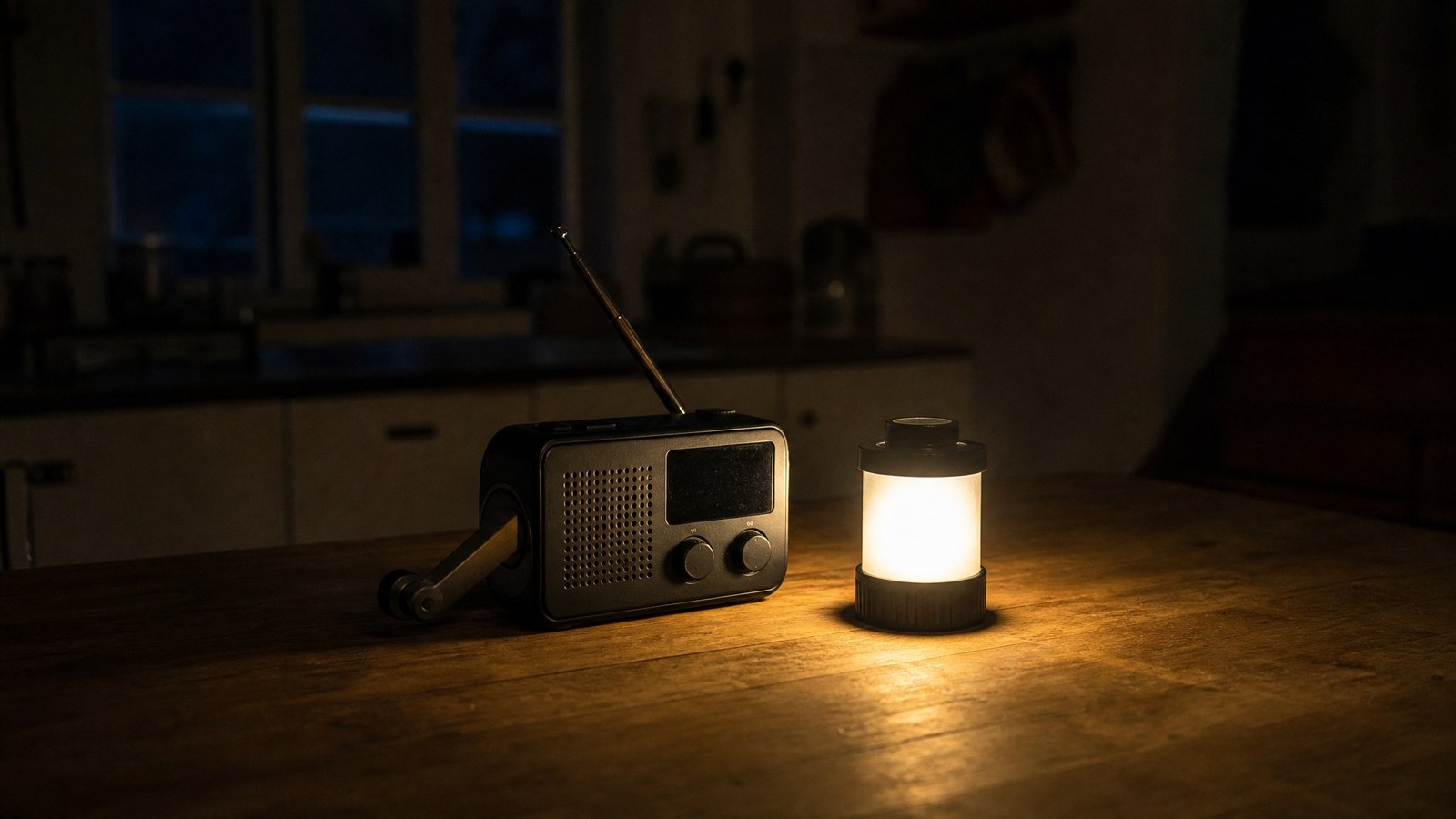
Your Phone Is Still The First Tool
Preparedness writing has a habit of skipping past the phone as though it were already dead. In most outages it is not, and it remains the only device in your house that reaches a dispatcher. Two published rules are worth knowing precisely, because they are routinely quoted against each other and both are correct.
The first is about reaching 911. The FCC's guidance on text-to-911 says you should always contact 911 by making a voice call if you can, because voice calls provide more information to 911 call centers. Its instruction has a second half worth carrying: if you are deaf, hard of hearing or speech disabled and text-to-911 is not available, use a TTY or a telecommunications relay service if possible. Text-to-911 is only currently available in certain locations. The FCC encourages call centers to begin accepting texts, and it is up to each call center to decide the particular method in which to implement and deploy the technology. Where a call center does request the service, FCC rules require wireless carriers and text messaging providers to deliver it in that area within six months. The FCC publishes a list of areas with available service, updated monthly. Where it is not yet available, FCC rules require wireless carriers and text messaging providers to send an automatic "bounce-back" message advising you to contact emergency services by another means, such as making a voice call or using telecommunications relay service. The FCC says those messages are intended to minimize your risk of mistakenly believing that a text to 911 has been transmitted to a call center when it has not. Two more limits are easy to miss: the rules do not apply to text messaging applications that do not support texting to and from U.S. phone numbers, and apps that only support texting other app users or texting via social media are not required to support text-to-911 at all. Your group chat is not a route to a dispatcher.
The second rule is about reaching your own household, and here the advice flips. Ready.gov's Make a Plan page, which sits in its Ready Kids section and is written for a family to work through together, says plainly: text, don't talk. In an emergency phone lines may be tied up, it may be easier to text, and texting leaves phone lines open for emergency workers. It also recommends picking the same contact for every family member and picking someone out of town, on the stated reasoning that they may be easier to reach in a disaster.
These are not in conflict, and neither source claims they are. The destination is what changes the rule. Calling is the preferred way to reach 911. Texting is the better way to reach each other, partly because it does not occupy a voice channel that emergency workers may need. Same phone, two different jobs.
The Four Radio Services Worth Knowing
Once you move past the phone, American personal radio splits into a handful of distinct services with genuinely different rules. People shop by looking at the radio. It is more useful to shop by looking at the service the radio operates in, because that is what sets your power, your channels, your antenna options and whether you need a license at all. The four below are numbered only so they are easy to refer back to. Nothing in the FCC's material ranks them, and they are not a progression.
| 01 | FRS: no license, and less range than you thinkThe Family Radio Service is what almost every consumer walkie-talkie is. It is licensed by rule, meaning no individual license is required as long as you follow the rules, you may operate one regardless of age, and you may use it for personal or business purposes if you are not a representative of a foreign government. FRS has 22 channels, all of them shared with GMRS, so you may hear licensed GMRS stations on them. Channels 8 through 14 are limited to half a watt of effective radiated power and the rest to two watts, and the FCC states the usual range on channels 8-14 is less than one-half mile, with longer range possible on channels 1-7 and 15-22 depending on conditions. An FRS transmitter must be certified by the FCC and may not be modified. No channel is anyone's exclusive property, so you are expected to cooperate in choosing channels to limit interference. One useful piece of history: in 2017 the FCC stopped authorizing dual-service FRS/GMRS radios and reclassified existing ones as either FRS or GMRS, specifically to remove the confusion over whether a license was needed. |
| 02 | GMRS: a license, no exam, ten years, whole family coveredThe General Mobile Radio Service is the step most preparedness-minded households should look at seriously. It is a licensed service on channels around 462 and 467 MHz, with 30 channels, and an FCC license is required to operate a GMRS system. The FCC limits eligibility for new GMRS system licenses to individuals, and states you may apply if you are 18 years or older and not a representative of a foreign government. Our own note, not the FCC's: nothing in that eligibility statement is an exam, which is the practical difference between GMRS and amateur radio below. Licenses run for a ten-year term, can be renewed from 90 days before expiration up to the expiration date, and once expired you must request a new license rather than renew. The part that makes it a household solution: if you hold the license, any family member, regardless of age, can operate stations and units within your licensed system. Range expectation, in the FCC's own words, is a communications range of one to twenty-five miles depending on station class, terrain and repeater use. Our own read: the top of that range is not a handheld-to-handheld figure. The FCC also notes that in transient use, a mobile station from one GMRS system may communicate through a repeater in another GMRS system with the permission of that system's licensee. Since 2017 it has also permitted limited data such as text messaging and GPS location information. In the FCC's words, you cannot directly interconnect a GMRS station with the telephone network or any other network for the purpose of carrying GMRS communications, though those networks can be used for remote control of repeater stations. Application fees are set by the FCC and change over time, so check the current amount on the FCC's site rather than trusting a figure in a blog post. |
| 03 | MURS: no license, five channels, and an antenna you are allowed to addThe Multi-Use Radio Service is the one most people have never heard of, and it has a property the others do not. MURS has five channels in the 151-154 MHz range, the old Part 90 "color dot" business frequencies, and it is licensed by rule, so no individual license is required as long as you are not a representative of a foreign government and you use the transmitter in accordance with the MURS rules. There is no age restriction. No MURS transmitter may exceed two watts of transmitter power output under any condition of modulation. Here is the interesting part: the FCC states the usual range between MURS stations is less than a few miles, but connecting a MURS radio to an external antenna can extend the range to ten miles or more. The difference is the antenna, not the radio: a MURS transmitter must be certified by the FCC just as an FRS one must, and the FRS page adds that an FRS transmitter may not be modified. So MURS is the unlicensed service where the FCC itself points at an external antenna as the way range grows. Check the current Part 95 Subpart J rules before you mount anything, since antenna limits sit in the rules rather than on that page. No station identification announcement is required, and as with the others, no interconnection to the telephone network and no exclusive channels. |
| 04 | Amateur radio: an exam, and a different kind of capabilityAmateur radio is the only one of the four that asks something real of you up front, and the only one where working past your own horizon without any infrastructure is on the table at all. The FCC currently issues three operator classes. They are Technician, General and Amateur Extra, plus three grandfathered classes (Novice, Technician Plus and Advanced) that are no longer issued. Exams are administered by volunteer examiners in your own community, the question pools are public, and study guides and courses are widely available. Technician, where most people start, means answering at least 26 of 35 written questions correctly, and its privileges include transmitting on channels in any of 17 frequency bands above 50 MHz with up to 1,500 watts of power, plus privileges in four HF bands. General adds another 35-question exam with the same 26-correct threshold and authorizes privileges in all 29 amateur service bands. Amateur Extra adds a 50-question exam requiring at least 37 correct and brings additional HF spectrum. Our own read on why that matters, and none of this comes from the FCC page: the HF privileges are the difference in kind rather than degree, because the other three services above are short-range by design. Two honest caveats on that. A GMRS repeater already reaches past your own line of sight, so this is not the only way to cover distance. And Technician, where most people start, is mostly a VHF and UHF licence with privileges in four HF bands, so the full HF picture arrives with General. If you want to hear and be heard beyond your own county with nothing in between, this is the path, and the exam is the price. |
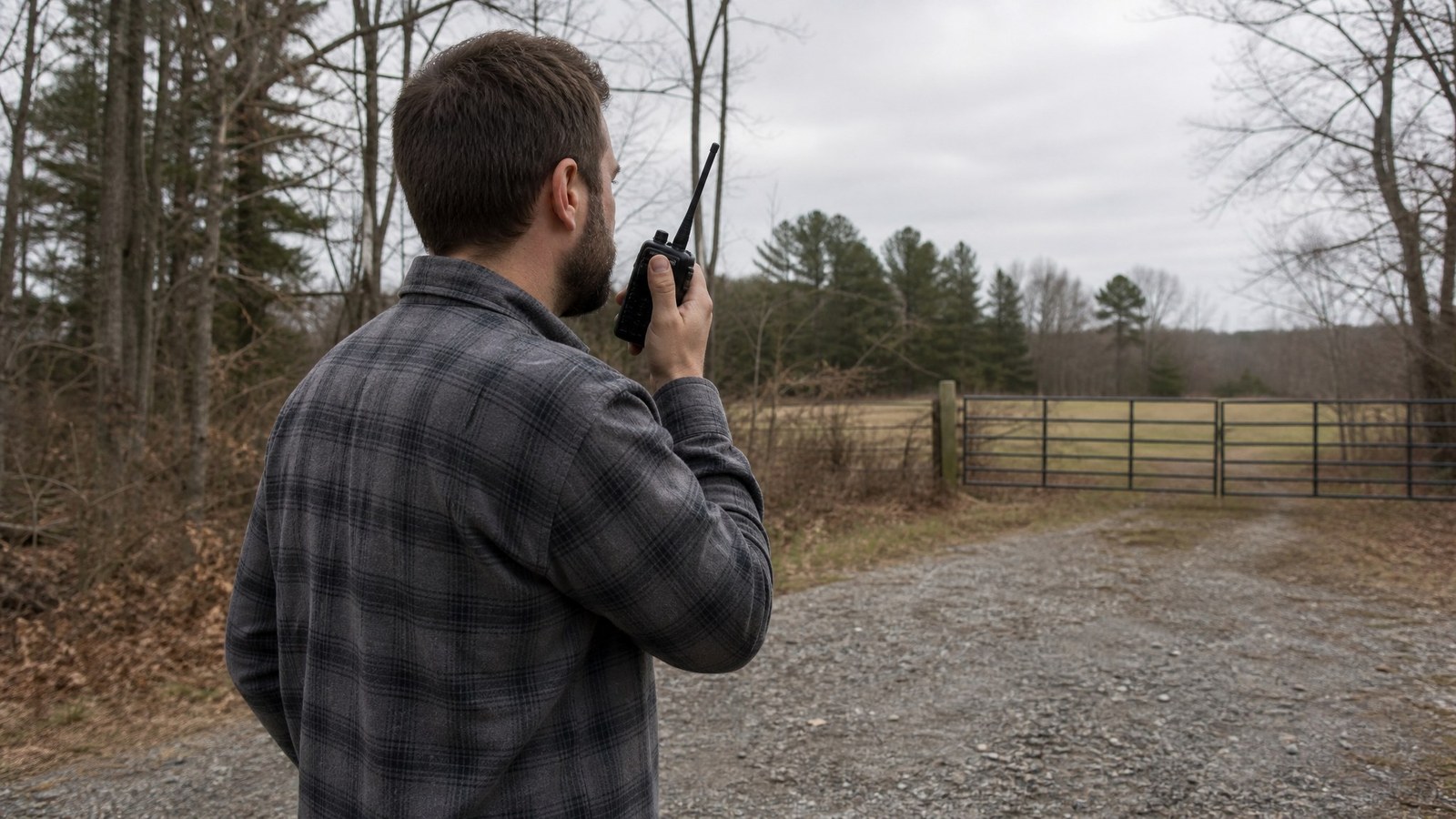
Read The Number On The Box, Then Read The Regulator'sConsumer radio packaging tends to quote a best-case figure measured with nothing at all in the way. The published expectations above are the ones to plan around: less than one-half mile on FRS channels 8-14, less than a few miles on MURS without an external antenna, and one to twenty-five miles on GMRS depending on station class, terrain and repeater use. Note whose qualifier is whose. The FCC names terrain explicitly only on GMRS; on FRS it says longer range is possible on the other channels depending on conditions, and it attaches no qualifier at all to the MURS figure. Our own view is that terrain drives all three. Test your own radios across the actual distance you care about, on the day, in the place. A hilltop-to-hilltop test tells you nothing about talking from your basement to a car two ridges over.
Everything Above Runs On Power
This is where most communication plans quietly fail, and none of what follows is agency guidance. It is just what goes wrong. A radio is a battery with a speaker attached. The plan has to include how that battery gets full and stays full.
Know which of your radios take common cells and which take a proprietary pack, because the answer changes what you stockpile. Keep a set of fresh cells stored outside the device rather than left in it for years. Treat a hand-crank or solar receiver as the backstop that works when everything else is flat, not as the primary. Remember that a vehicle is a generator with a 12-volt outlet, which makes the car the charging station for the whole household during a long outage. And charge before the storm arrives, not after the lights go out, which sounds obvious right up to the evening it isn't.
Then test on a schedule. A radio that has sat in a drawer for three years with a swollen pack in it is not equipment, it is a paperweight you are counting on. Twice a year, turn everything on, run it for a few minutes, and confirm the batteries still hold. Our guide to preparing for a power outage covers the wider household picture, and our friends at 1st Hour have a first-hour walkthrough for the moment the lights actually go out.
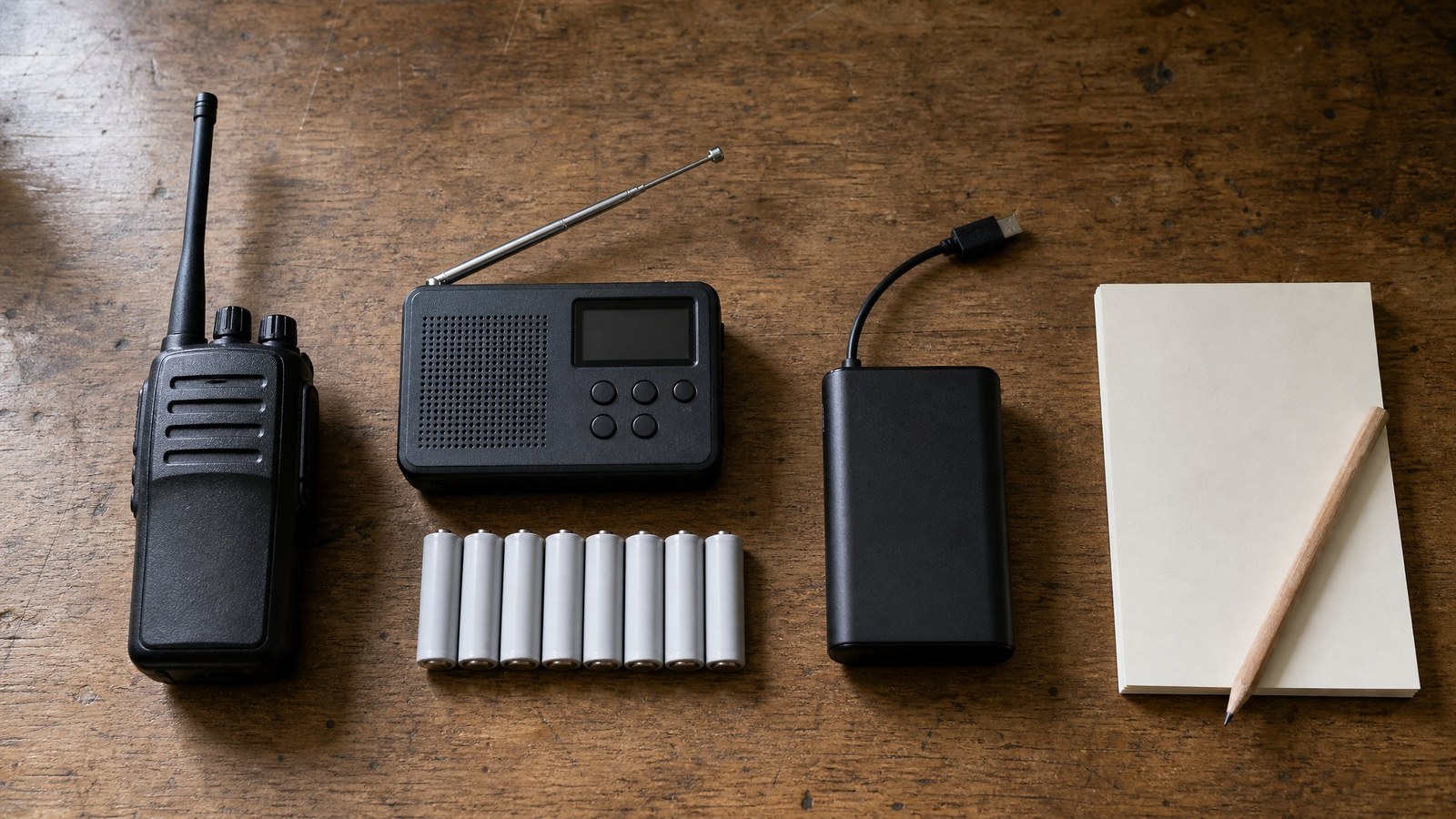
The Plan Is The System, Not The Radio
Two radios and no agreement is worse than no radios and a good one. The agreement is the part that costs nothing and gets skipped.
Ready.gov's Make a Plan page, in its Ready Kids section, gives the bones of it. Pick the same person for each family member to contact, and pick someone out of town, since they may be easier to reach in a disaster. Text rather than talk, because lines may be tied up, it may be easier to text, and it leaves phone lines open for emergency workers. Decide on safe, familiar, accessible places your family can go for protection or to reunite, and consider places in your house, in your neighborhood, and outside of your city or town, so you are prepared for any situation. Then write it down. Make sure everyone in the family has copies and keeps them in a safe space, like in a backpack, wallet, or taped in a notebook, put them in the phone as well, and hold regular household meetings to review and practice. The three-rings framing of that last list is ours, not Ready.gov's.
Three additions of our own that turn that into something a radio can execute. First, set a check-in window rather than a check-in time: the top of every hour for five minutes, with the radios off in between to save power. Second, agree a channel and a fallback channel in advance, in writing, because none of these services gives anyone an exclusive channel and the one you picked may be busy. Third, decide the trigger for abandoning comms and executing the meeting-place plan instead: if nobody answers by the second window, stop calling and start moving. A plan with no exit condition leaves people sitting in a parking lot pressing a button.
1st Hour's guide to building a family emergency plan that actually works is the fuller treatment of the planning side, and it pairs with this one.
When Nothing Electronic Works
Every layer above eventually runs out. Batteries die, terrain wins, and repeaters go down with the power. The last layer is the one that needs no power at all, and it is worth practicing precisely because it feels antique: a whistle, a signal mirror, high-visibility material, and a ground signal large enough to read from the air.
Two of our earlier guides go deep on that side of it. Our walkthrough of signaling for help in a wilderness emergency covers the methods and the patterns the agencies recommend, and basic land navigation without GPS covers the other half of the same problem, which is knowing where you are well enough to tell someone.
There is a reason to learn those even if you own every radio in this article. Anything you can do without a device is the only capability that cannot be switched off.
What Turns This From A Project Into A Non-Event
The household that handles a long outage well is rarely the one with the most impressive radio. It is the one that already had a weather receiver on the shelf with the local frequency written on it, a pair of charged handhelds in a known drawer, spare cells still in the wrapper, a headlamp, and a card in the kitchen that says where everyone goes and who they call.
None of that is exotic. It is the sort of thing that accumulates in a kit over time and then makes an ugly week merely inconvenient. If your kit is still coming together, our bug-out bag essentials breakdown covers the wider load, and the survival skills worth learning first covers what to practice before you need any of it.
Start with receiving. Add a short-range way to talk to your own people. Write the plan down. Everything after that is refinement, and refinement is a pleasant problem to have.
Get the Grid-Down Comms Card as a Printable PDF
The seven NOAA frequencies, the four services side by side with their published ranges, the 911 rules, and blank lines for your station frequency, SAME code, channel plan and check-in window, on one sheet for the kitchen drawer.
Download the Comms Card (PDF)Have The Gear Before The Lines Go Down
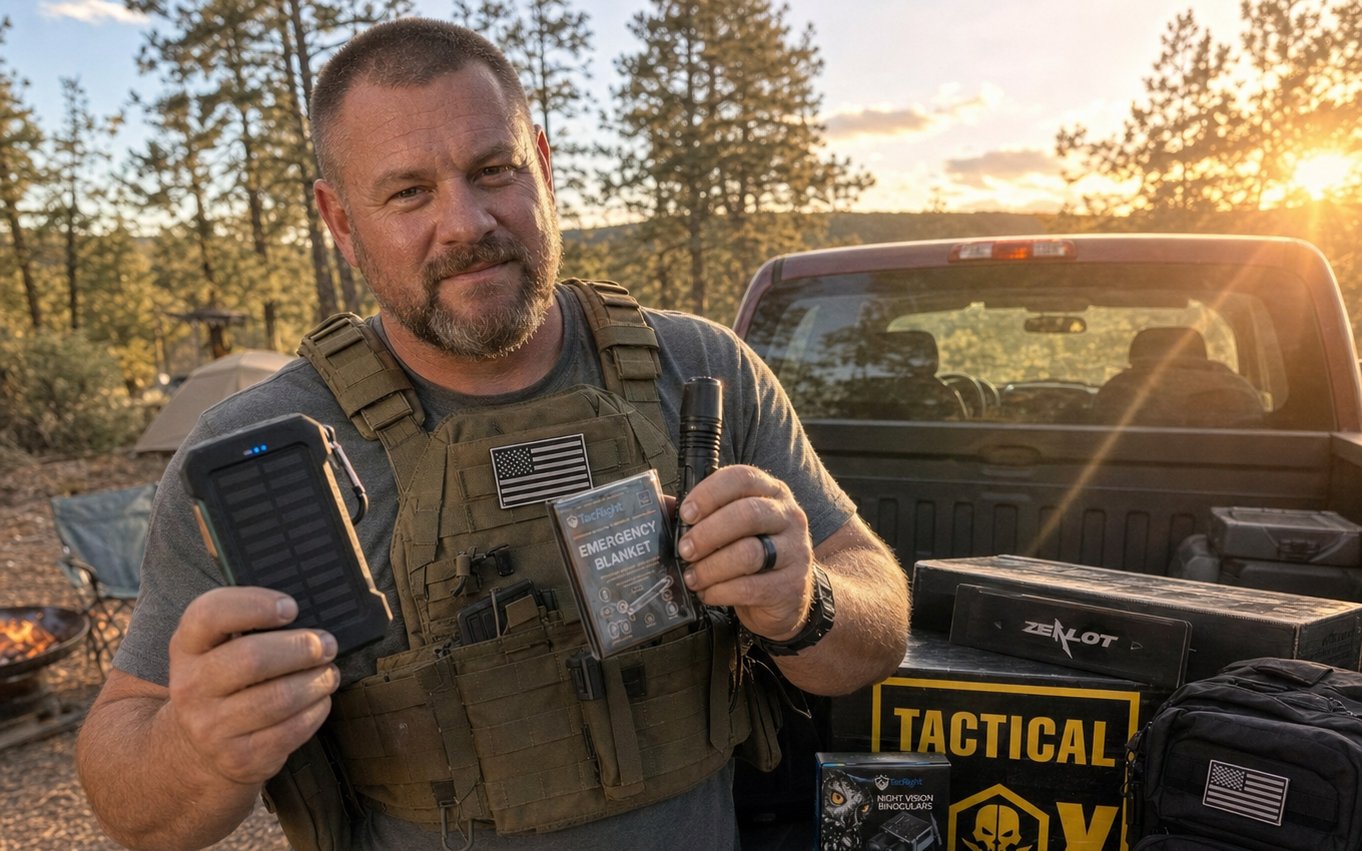
Every month, TacticalBox members get hand-picked tactical, survival, and outdoor gear, sourced ourselves from makers all over the country and curated to be some of the best equipment on the market, worth $150 or more per box on the Standard plan. Subscribe once and the right gear keeps showing up before you need it, backed by a money-back guarantee. Cancel, pause, or skip anytime.
Get Your TacticalBoxThis content is for informational and educational purposes only. Radio regulations, license terms, application fees, channel allocations and power limits are set by the FCC and change over time, so verify current rules on the FCC's own site before you buy, apply, or transmit, since operating outside the rules for a service can carry penalties. NOAA Weather Radio coverage varies by terrain and transmitter, and reception in some counties is partial or unavailable. Text-to-911 availability varies by 911 call center: contact 911 by making a voice call if you can, and if you are deaf, hard of hearing or speech disabled and text-to-911 is not available, the FCC directs you to use a TTY or a telecommunications relay service if possible. In any emergency, follow the current instructions of your local emergency management and public safety authorities.