How to Signal for Help in a Wilderness Emergency
Stop moving. Every step you take after you are lost makes the search area bigger. Then work outward: call 911 if you have any bars at all, and activate a satellite beacon or messenger if you carry one, because that is the only signal that leaves the valley on its own. Whichever you have, do it first. After that, get loud and get seen. Three whistle blasts, pause, three more. Three quick, three slow, three quick with a flashlight after dark. A mirror flash at any aircraft you hear, which the FAA says has been spotted from over 25 miles. Three fires in a triangle, or a bright panel and rock shapes laid out big enough to read from the air. And do the one thing that beats all of it: tell somebody your route before you leave.
Nobody plans the day they need this. A trail junction gets missed, weather rolls in, an ankle rolls on wet talus, and suddenly the problem is not where you are going but whether anyone can find you. The uncomfortable part is that rescue is a two-way job. Search teams are good at their work, but they are looking for a person-sized object in a landscape measured in square miles. Your job is to stop being a needle and start being a flare.
Time matters more than most people assume. The National Search and Rescue Plan, quoted in the FAA's Search and Rescue section, puts it plainly: the life expectancy of an injured survivor decreases as much as 80 percent during the first 24 hours, and the odds for uninjured survivors drop off quickly after the first three days. That is the clock. Everything below is about shortening the time between the moment you are in trouble and the moment somebody knows where to look.
Before Anything Else, Stop Walking
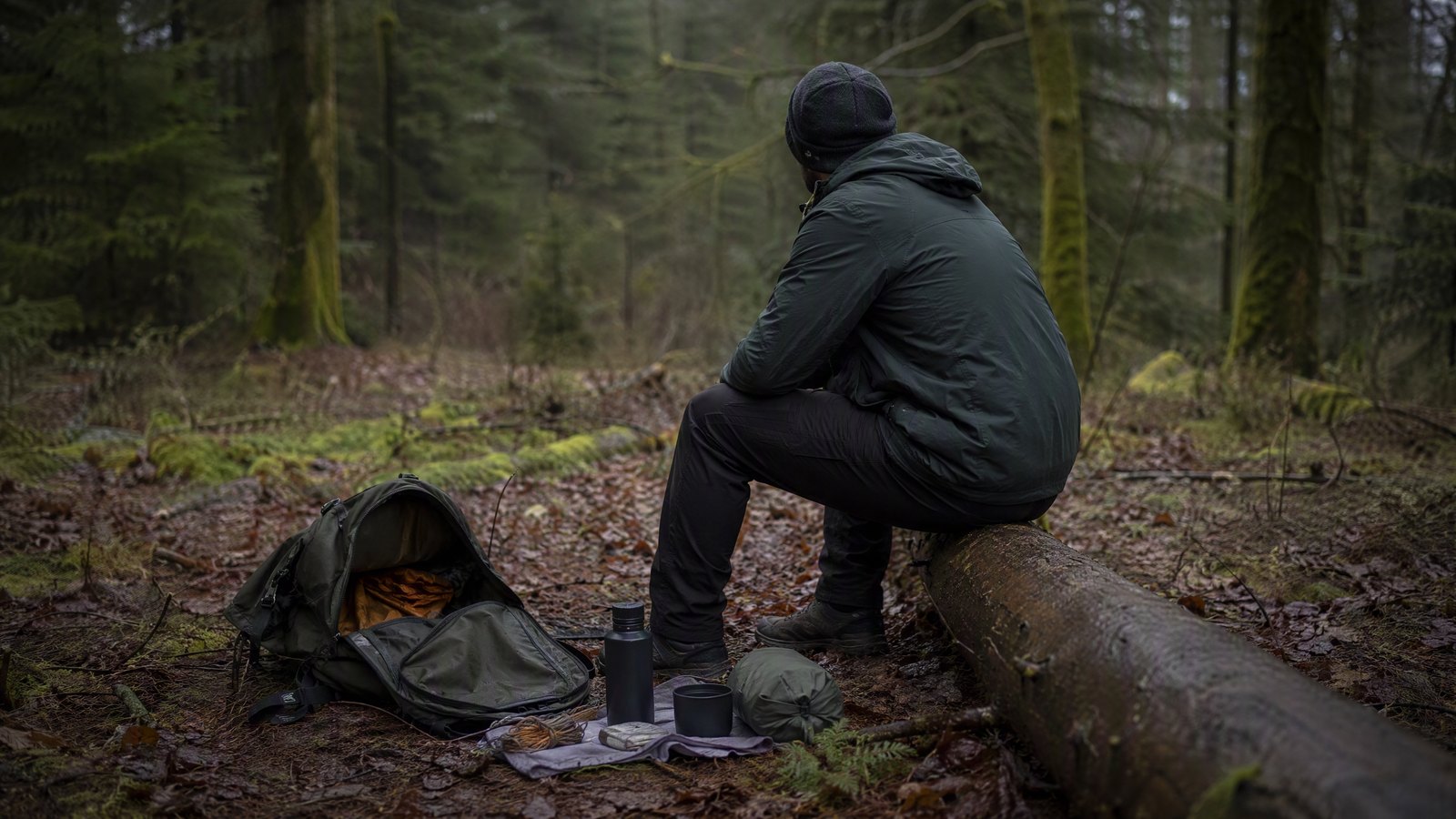
The instinct when you realize you are lost is to keep moving and find your way out. It is almost always the wrong instinct. The National Park Service is direct about this in its Outdoor Emergency Plan: changing location makes it difficult for authorities to find you, and you should move only if there is an immediate threat to your life. Search planners start from your last known position and work outward. Every mile you wander turns a manageable circle into a much larger one.
The FAA's survival curriculum teaches an acronym for the first few minutes that is worth borrowing on foot. It is S.T.O.P.: sit, think, observe, plan. Sit down and drink some water. Think the situation through instead of reacting to it. Observe what you actually have, injuries included, and inventory your pack. Then make a plan. Those four steps take ten minutes and they are the difference between a controlled problem and a spiral.
If you have any cell signal at all, call 911 before you do anything else. The Park Service's list of what to tell them is worth memorizing: GPS coordinates from your phone if you can get them, the name of the trail or area where you started, your last known location before you got turned around, a description of your surroundings and any landmarks you can see, the type and color of the clothing you are wearing, what equipment you are carrying, and any medical conditions. A text sometimes gets out where a call will not, so try both.
The Signal That Leaves the Valley
Whistles and mirrors only reach as far as somebody's eyes and ears. A 406 MHz distress beacon reaches a satellite. That is the whole argument for carrying one, and it is why a personal locator beacon or satellite messenger is the single highest-value piece of signaling gear you can put in a pack.
NOAA's SARSAT program explains how it works. Personal locator beacons are handheld units, most of them about the size of a phone, activated manually and transmitting only on 406 MHz. Models with a GNSS chip encode your position into the distress message, which NOAA says narrows the location down to roughly 100 meters, about the size of a football field. Operational battery life once activated is a minimum of 24 hours, and every beacon carries a second low-power homing signal so rescuers can close the last distance once they are near. All of it is built to reach a satellite more than 22,000 miles up, through cloud cover and weather.
Two things to know before you rely on one. First, registration is free, required, and genuinely useful. NOAA's point is that a registered beacon lets rescue authorities contact you to confirm a real emergency before launching a search, and lets them know who and what they are looking for when it is real. Second, the old 121.5 MHz beacons are not a backup plan. NOAA notes that Cospas-Sarsat satellites stopped monitoring that frequency in 2009, so anything transmitting on 121.5 alone depends entirely on an aircraft happening to overfly you with a receiver on.
Beacon or not, the same logic applies to your phone. Newer handsets with satellite emergency features can push a message out from places with no cell coverage. Learn how yours works while you are sitting on your couch, not while you are cold and scared in a drainage.
Sound and Light: Three of Anything
The convention that search teams listen and watch for is a group of three. Three whistle blasts, three fires in a triangle, an SOS pattern built out of threes. It is not a superstition, it is a way of separating a deliberate human signal from the background noise of birds, wind, and passing headlights.
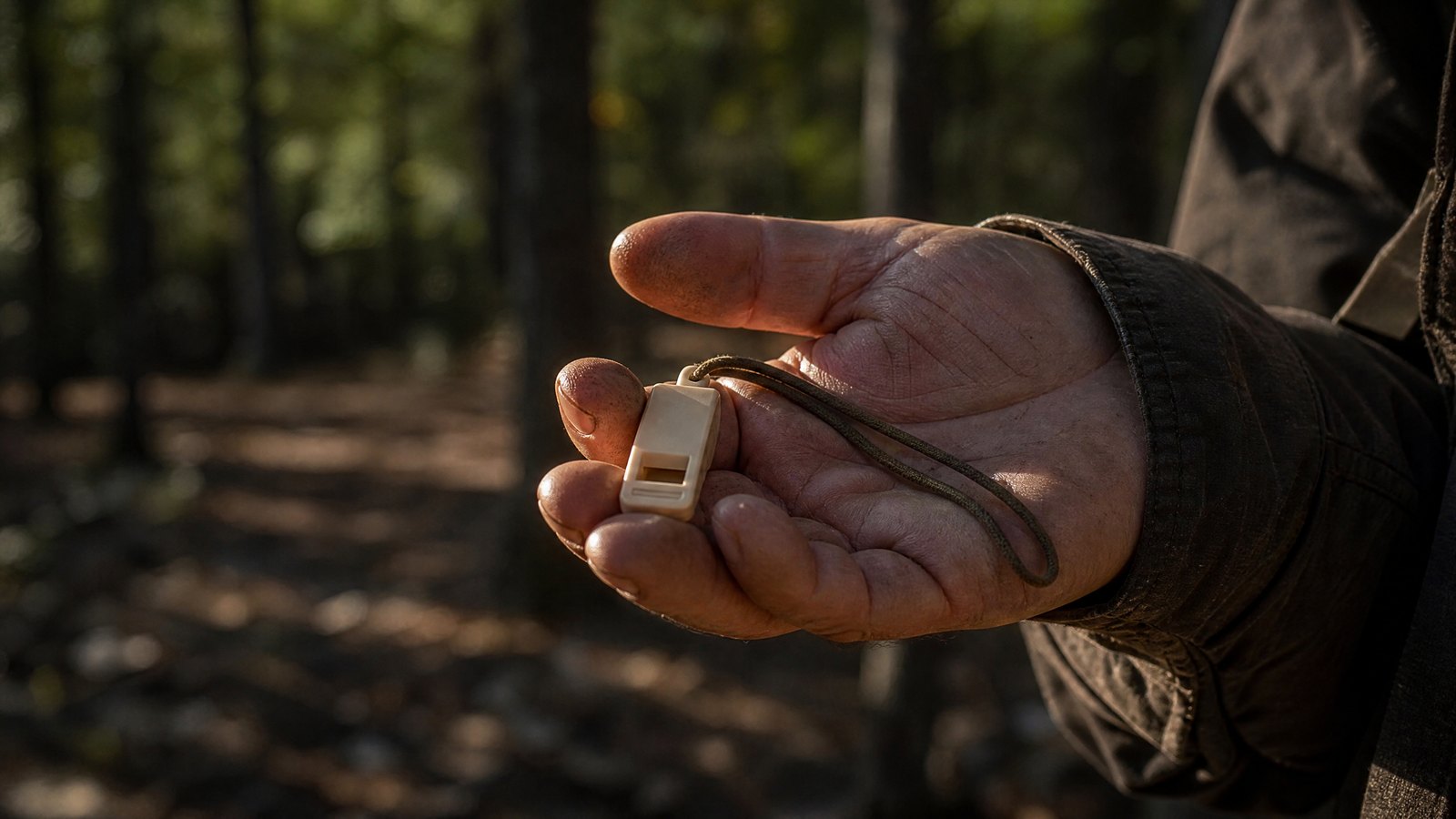
The whistle is the most underrated item in a pack because it does something your voice cannot: it works for hours. The Park Service recommends packing one specifically because blowing a whistle helps people find you and saves your energy from yelling, and its instruction is exactly what a ground team expects to hear. Blow three times, take a break, blow three times again. Shouting shreds your voice quickly and carries a fraction as far. A whistle costs a few dollars and weighs nothing, which is why it belongs on a zipper pull rather than in the bottom of a pack.
After dark, light does the work. The Park Service's guidance is to flash the SOS pattern with your flashlight: three times quickly, three times slowly, three times quickly. Use it deliberately rather than constantly, because batteries are finite and you may need days out of them. A dedicated strobe is better if you have one. The FAA notes that a strobe run continuously should keep flashing for up to nine hours, and that an aircraft may well see your light before you ever hear the engine. A chemical light stick swung on a length of cord makes a surprisingly large moving circle in the dark and costs nothing in battery.
Do not overlook the fact that light travels much farther at night than any of this does in daylight. If you have a headlamp and you hear or see anything at all after dark, aim it and use the pattern.
Daylight Signals: Mirror, Smoke, and Fire
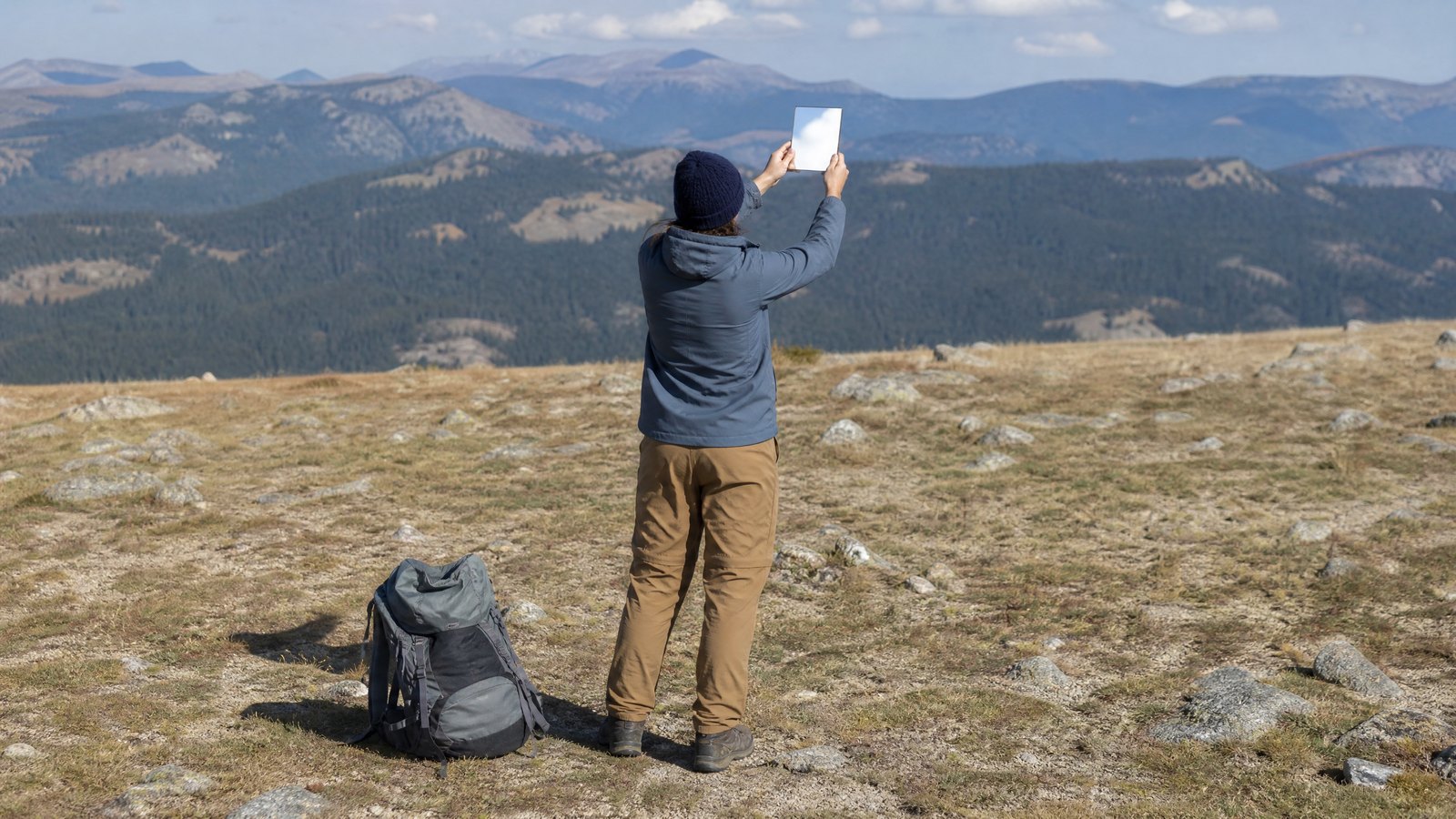
In daylight the mirror is king. The FAA's survival manual calls the signal mirror one of the most effective visual signaling devices available and reports that flashes have been spotted from over 25 miles. It works best on a clear sunny day but remains useful under overcast, and it never runs out of battery, which is exactly why the Park Service tells hikers to pack one alongside the whistle.
Using one is simpler than the internet makes it sound. Angle the reflective face toward the sun and sweep the flash slowly along the horizon, even when you cannot hear an aircraft, because you have nothing to lose by sweeping. If you do have a target, walk the flash onto it and hold it there. A mirror can also be hung from a branch on a string so it turns and throws light while your hands are busy with something else. And if you do not have a purpose-built mirror, anything reflective works: a phone screen, a foil blanket, the polished back of a piece of gear.
Fire is the other daylight and nighttime option, with one hard caveat: do not build one if there is high fire danger or an active wildland fire season where you are. Turning a rescue into an ignition source is a catastrophic trade. When fire is safe, the FAA notes that three fires arranged in a triangle are recognized internationally as a distress signal, though any fire out in the open is better than none.
Smoke is about contrast, not volume. Against snow or pale rock you want dark smoke, produced by burning rubber, plastic, petroleum products, or evergreen boughs. Against dark timber you want white smoke, produced by piling on green wood, green or dry leaves, moss, peat, or ferns. Keep out of the smoke plume when burning anything synthetic, since it can carry toxic compounds. Hotter fires push smoke higher, and height is what makes it visible from a distance.
Being Seen From the Air
If a search is underway, some of it will happen from a helicopter or a fixed-wing aircraft flying a grid. From up there, a human being in earth-toned clothing under tree cover is close to invisible. Everything you do on the ground should be about breaking that up.
The FAA teaches a checklist for improvised signals under the acronym CCLAS, and it is a genuinely good framework. Condition: check your signal periodically and keep it in good repair. Contrast: it has to stand out from what is around it. Location: put it somewhere high and visible, an open meadow, a gravel bar, a bald knob, not a shaded creek bottom. Angularity: nature does not do straight lines, so straight lines read as human from the air. Size: build it big, at a six-to-one ratio, with 18 feet by 3 feet as the preferred size.
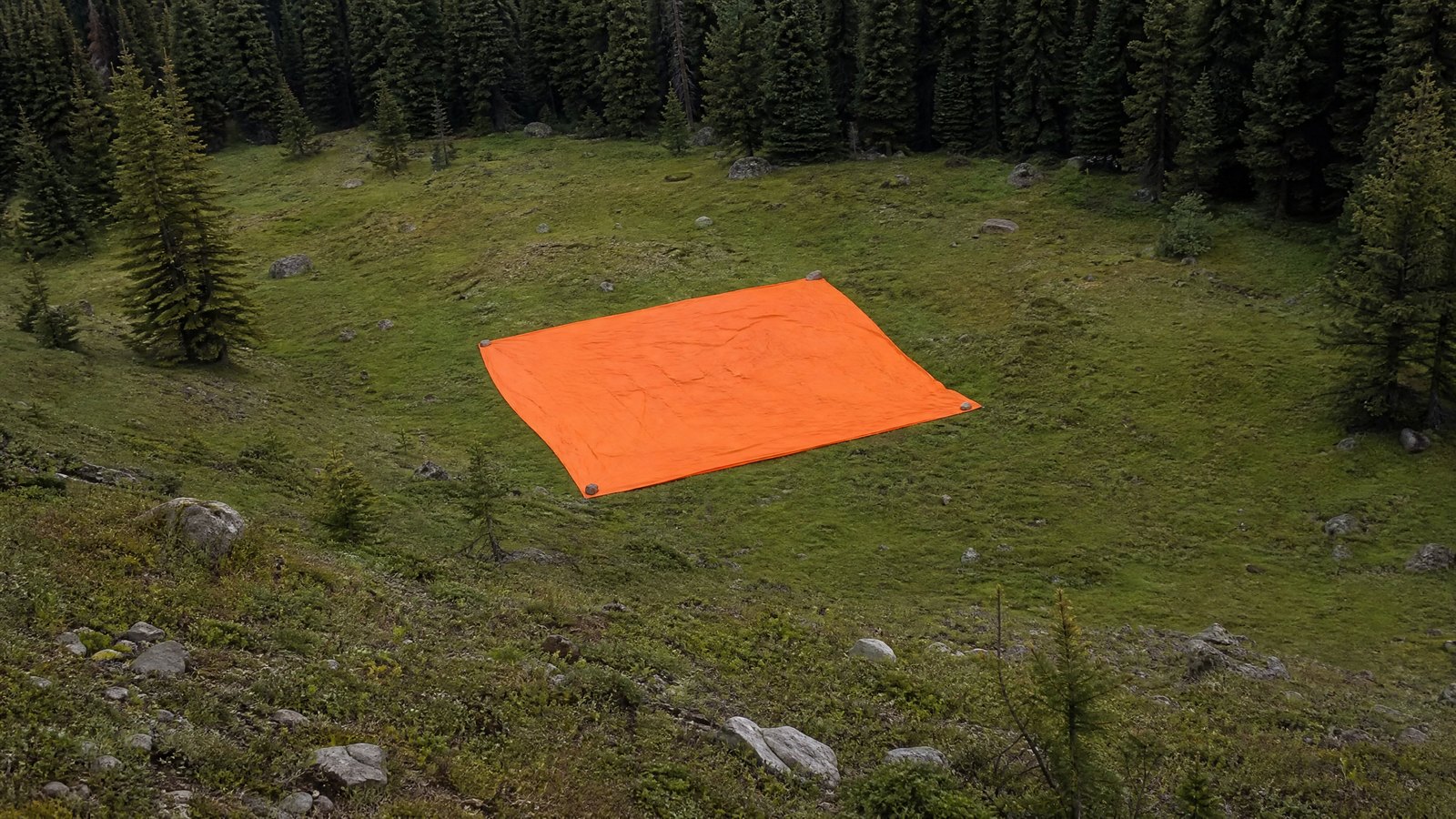
Material can be anything: an emergency blanket, a tarp, a bright jacket, rocks, logs, boughs dragged into shape, or a trench stamped into snow. A single large panel of hard color in an open clearing is already a strong signal. If you have the energy and the daylight, shapes carry an actual message. The FAA's survival manual publishes a standard set of ground-to-air symbols for survivors, reproduced below.
Codes as published in the FAA's Basic Survival Skills for Aviation manual. Other agencies and countries publish slightly different sets, so treat these as a useful default rather than a universal language. If you can only manage one thing, make it big and make it contrast.
One more piece of aircraft etiquette. If a plane or helicopter circles you, it has probably seen you. Keep signaling anyway until you are certain, then stay where you are so the ground team can reach the spot the pilot marked.
Put It in Order
Under stress, people reach for whatever is in their hand instead of whatever is most likely to work. Fixing that is a matter of deciding the order now, while it costs nothing.
Notice that the gear in that list is small, cheap, and light. A whistle, a mirror, a headlamp with spare batteries, a foil blanket, a lighter, and something bright to lay out. All of it fits in a jacket pocket and none of it needs charging. That is the entire point of carrying it in the first place, and it is the same logic behind a well-built everyday carry kit or bug-out bag.
The Signal You Send Before You Leave
Here is the part that does more for your odds than every mirror and beacon combined, and it is free. Tell a specific person where you are going, what route you plan to take, and when you expect to be back. Then tell them what to do if you are not.
The reason is arithmetic. A search cannot start until someone reports you overdue, and nobody reports you overdue if nobody knows you were due. The clearest illustration of the gap comes from aviation, where the same logic applies. The FAA cites an Air Force review of 325 search and rescue missions over a 23-month period, which found that for pilots flying without a filed flight plan, roughly 36 hours normally pass before family concern alone initiates an alert. Hiking has no equivalent of a filed flight plan, which is exactly why the note you leave behind is doing that job. A written plan left with one reliable person collapses that gap to almost zero.
Fill out a trip plan, leave it with a trusted contact who is not coming with you, and wear bright clothing so you are easier to spot if it ever comes to a search. Add a photo of your group taken at the trailhead that morning, which gives searchers exactly what you were wearing. It takes five minutes at the parking lot.
Signaling is one piece of a larger skill set. Knowing where you are in the first place is the other half, which we covered in basic land navigation without GPS. And once staying put becomes the plan rather than the problem, our friends at 1st Hour wrote a solid field guide on what to do when you are lost in the wilderness, including how to sequence shelter, water, and first aid while you wait.
None of this is hard. It is a whistle you actually carry, a mirror you have flashed at a friend across a field once so you know how it feels, a light pattern you can do without thinking, and a habit of telling someone where you went. Practice the pieces on an ordinary Saturday when nothing is wrong. The whole reason to learn them now is so you never have to learn them later.
Get the Wilderness Signal Card as a Printable PDF
The seven-step sequence, the whistle and light patterns, the ground-to-air codes, and a fill-in trip plan you can leave on the kitchen counter. One sheet, folds into a map case.
Download the Signal Card (PDF)Take 25% Off Your First Box
Every month, TacticalBox members get hand-picked tactical, survival, and outdoor gear, sourced ourselves from makers all over the country and curated to be some of the best equipment on the market, worth $150 or more per box. Subscribe once and the right gear keeps showing up before you need it, backed by a money-back guarantee. Cancel, pause, or skip anytime.
Claim 25% OffThis content is for informational purposes only and is not a substitute for formal wilderness survival or search-and-rescue training. Signal fires and smoke can start wildfires. Do not build one where fire danger is elevated or where fires are restricted, and follow all local land-management rules. Always tell someone your route and expected return time before heading into the backcountry, and call 911 first if you have any cell or satellite coverage.