
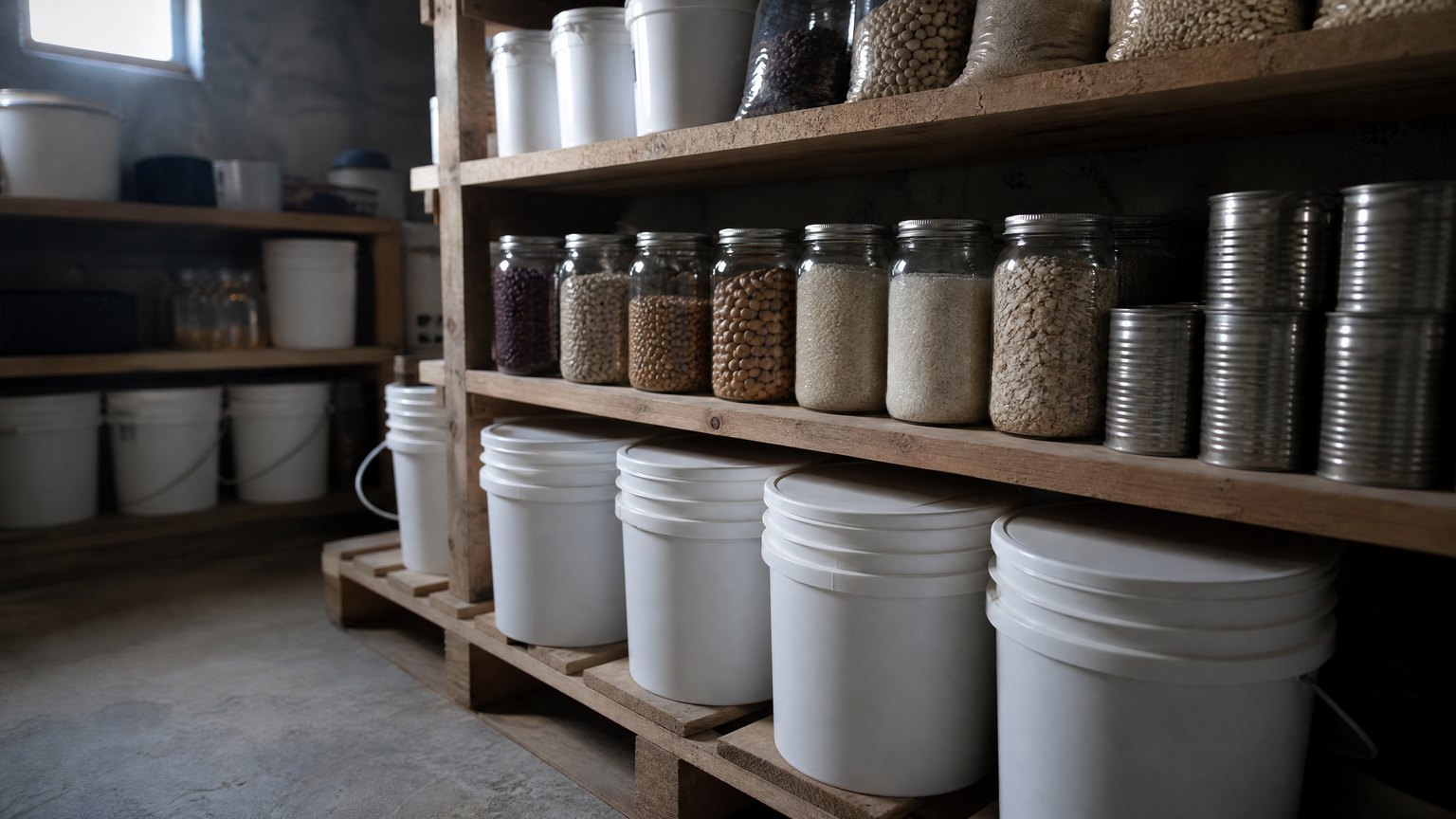
How to Store Emergency Food Long-Term
Cool, dry, dark, sealed, and rotated. Temperature is the single biggest lever you control, and a constant 40 to 60 degrees beats a garage that swings from 30 to 110. Store dry things only. If a food holds more than about 10 percent moisture, sealing it in an oxygen-free container creates a botulism risk rather than preventing one. Fat is the other clock: white rice, wheat, beans and oats keep for decades, while brown rice goes rancid in months and whole-milk powder is ruled out of long-term storage entirely, both because of the oil in them. Dates printed on packages are quality dates, not safety dates, with infant formula the one exception. Use the oldest thing first and check the shelf every few weeks.
Most people buy the food before they solve the storage. That is the wrong order, because when you store emergency food long-term the number printed on the bucket is not really a statement about the food. It is a statement about conditions you have not agreed to yet. The same sealed bucket of rice is a 30-year item in a cellar and a 10-year item in a 70-degree spare room, and the difference is not the rice.
Worth hearing from a source with no product to sell. Utah State University Extension's Food Storage booklet puts it bluntly: expiration dates are not required by law, so there is little oversight of them, and some food storage manufacturers list expiration dates of 10, 20, and even 30 years on their products. Extension's assessment of those numbers is that they are rarely scientifically determined and are more of a marketing claim. That is not a reason to distrust storage food. It is a reason to understand what actually sets the clock, so you can read any label yourself.
Step One
Decide How Much Before You Decide What
Volume is the part people either skip or wildly overshoot. Start with water, because it is heavier, more urgent, and the thing most pantries are short on.
Ready.gov says to store at least one gallon of water per person per day for several days, for drinking and sanitation. The reasoning behind the gallon is useful: a normally active person needs about three quarters of a gallon of fluid daily from water and other beverages, and the rest of the gallon covers washing and cleaning. Ready.gov attaches real qualifiers to that figure. Individual needs vary with age, health, physical condition, activity, diet and climate. Children, nursing mothers and sick people may need more. In very hot temperatures, water needs can double. It also gives one instruction that runs against instinct: never ration drinking water unless ordered to do so by authorities. Drink what you need today and go looking for more tomorrow.
On food, two federal sites word the same advice differently, and it is worth knowing which is which. Ready.gov's food page says to store at least a several-day supply of non-perishable food, without naming a number. FoodSafety.gov is the one that gives a hard figure, telling you to plan to have at least a three-day supply of food on hand and to store at least a three-day supply of water for each person and each pet. If you see "three days" quoted as the federal standard, that is where it comes from. There is no single number across agencies, so treat three days as the floor rather than the goal.
Three days is also where most people stop, and it is the least interesting part of the problem. A three-day pantry needs no technique at all. Everything below is about the shelf that has to survive a year of summers.
Step Two
The Four Things That Ruin Stored Food
Extension lists the factors that affect stored food in this order: temperature, moisture, oxygen, light, plus infestation and shelf date. Its own storage-conditions page calls moisture and temperature the two critical factors. Get those two right and the rest get easier.
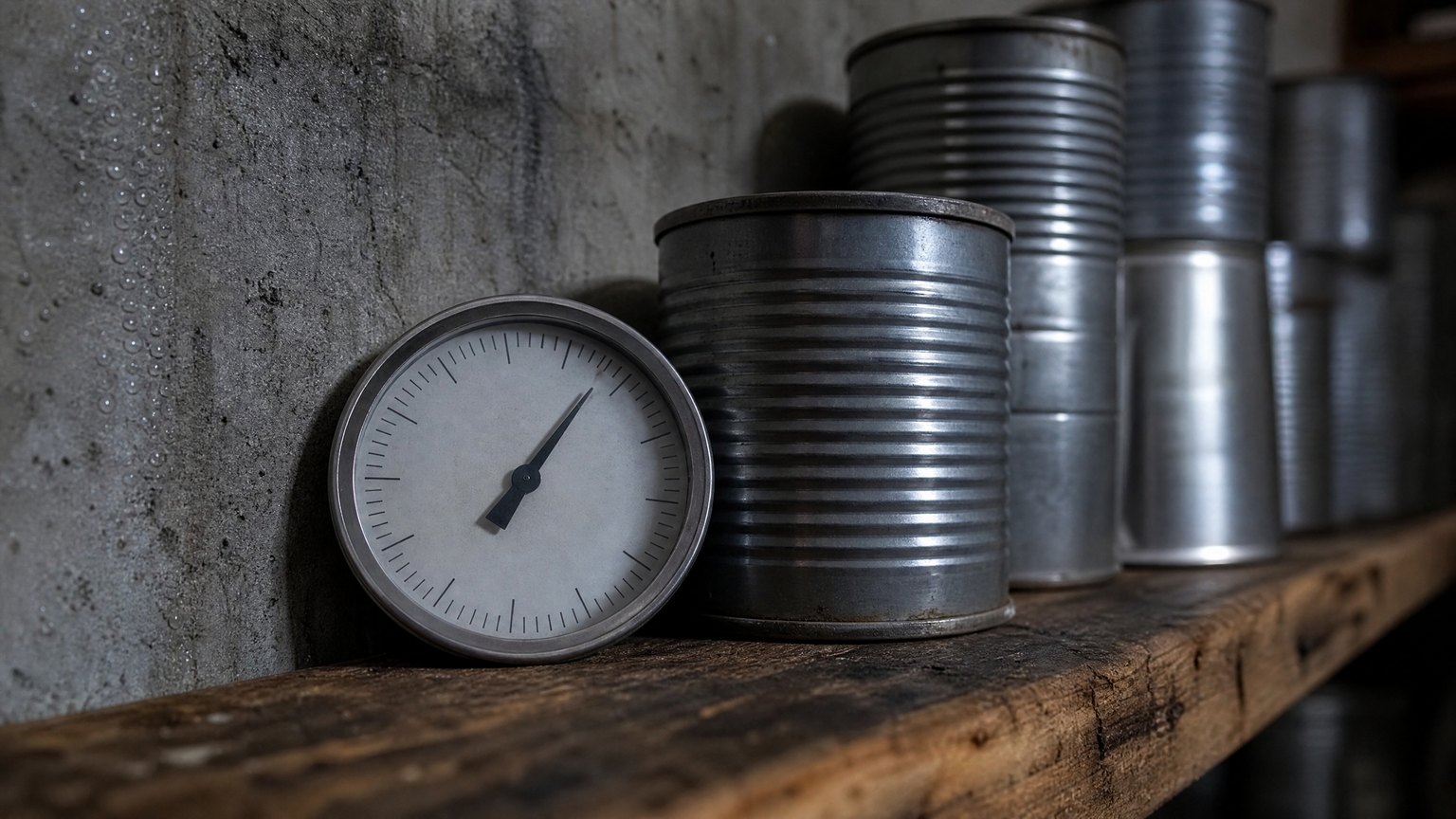
USU Extension, citing USDA, gives the figure that makes the whole subject click: for every 10.8 degrees of temperature rise, the shelf life of stored food is decreased by half. Extension's recommended range is a constant 40 to 60 degrees, and it flags fluctuating temperatures as damaging in their own right, not just high ones. A cabinet that cycles warm and cool all day is working against you even if the average looks fine.
If that halving rule sounds like a generalization, the USDA's Food Safety and Inspection Service publishes an actual table of storage life against temperature. Their shelf-stable food guidance gives storage life for military-style rations at different temperatures:
Shelf life for meal-ready-to-eat rations by storage temperature, from the FSIS Shelf Stable Food Storage Chart. Note the shape of it. Every ten degrees you take off multiplies the shelf life by roughly one and a half to two times, right the way down the range, which means a hot pantry has the most to gain rather than the least.
The three sources most worth trusting give three different "best" ranges, and that is not a contradiction, because they are answering slightly different questions. Extension's 40 to 60 degrees is about dry staples. FoodSafety.gov's 40 to 70 degrees covers canned and dried foods together, which is why it is the widest of the three, alongside its advice that the ideal location is a cool, dry, dark place. FSIS is talking specifically about cans when it says temperatures above 100 degrees are harmful, that the risk of spoilage jumps sharply as storage temperatures rise, and that below 85 degrees is best. Pick the range that matches what is actually on your shelf.
Moisture is the second enemy and the one with a safety consequence rather than only a quality one. Extension's wheat storage guidance puts numbers on it: a moisture level above 12 percent encourages mold growth, moisture above 15 percent will allow molds to grow, and at 20 percent some bacteria can start to grow. This is why "dry" is not a vibe. It is a specification.
Light is the mildest of the four, and it is worth not overstating. Extension notes that light degrades both nutritional content and appearance, naming fat-soluble vitamins A, D and E, fats and proteins as the sensitive ones, and it can leave food looking two-toned. Extension also says that although unappealing in flavor and color, it should still be safe to consume. Opaque containers and a dark room protect quality and nutrition rather than safety.
One placement detail that gets inflated into a myth. Extension says to keep containers off concrete floors, and the reason it gives is specific: concrete can wick moisture to stored containers and encourage rusting. That is an argument against direct contact with the slab, not against having a storage room with a concrete floor. A cheap pallet or a length of scrap lumber solves it.
Step Three
What Actually Keeps, and What Quietly Does Not
Here is where most storage plans go wrong, and it is almost always the same mistake. People buy the wholesome-sounding version of a staple and get a fraction of the shelf life.
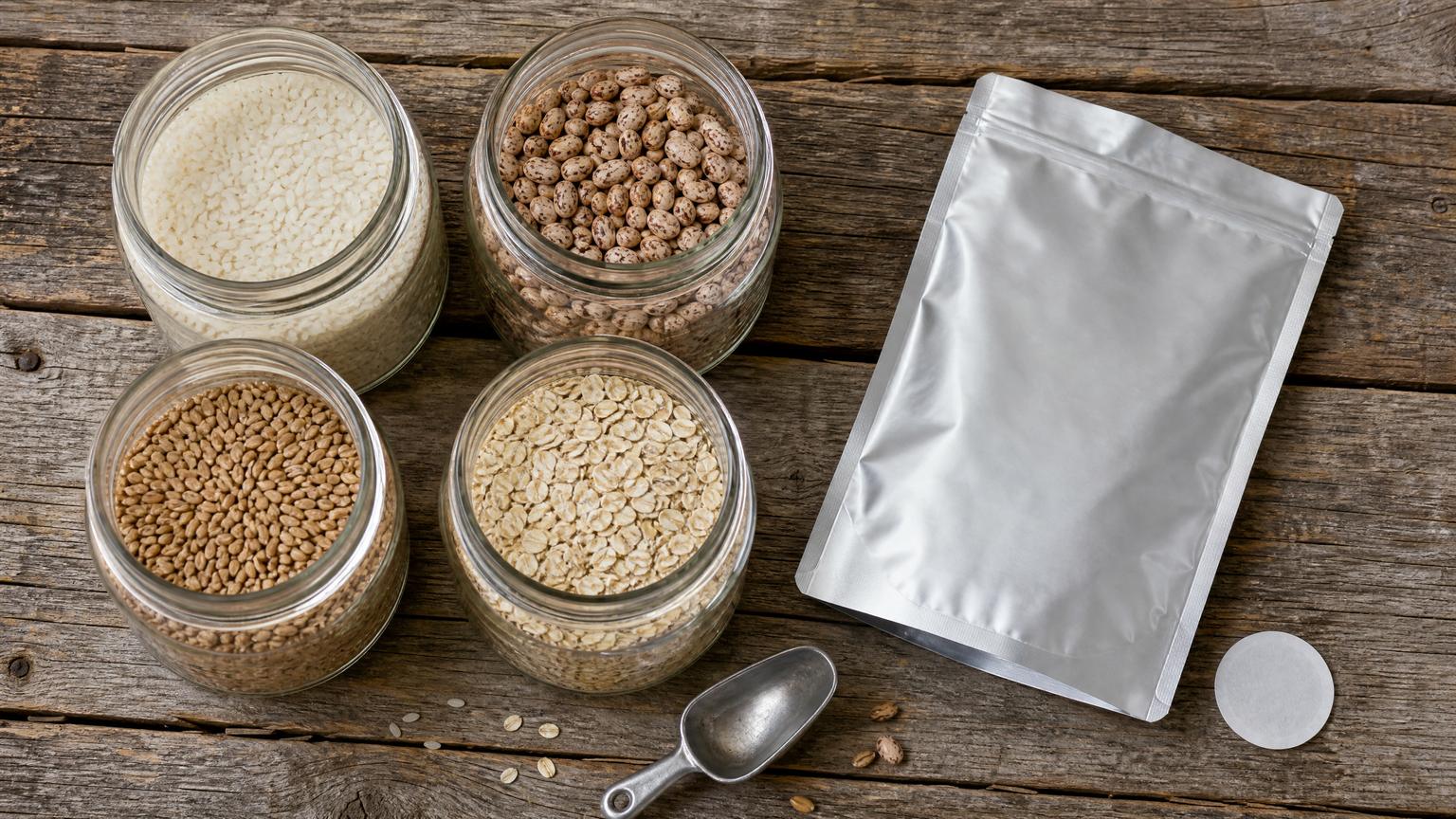
Figures from Utah State University Extension's storage research pages and its Food Storage booklet. Every one of these is conditional on temperature and sealing, which is the whole point of the table.
Read down that list and one pattern does all the work. Fat is the clock. White rice keeps for decades and brown rice keeps for months, and the entire difference is the oil in the bran layer. The same rule explains the most commonly bought mistake in the category. Extension is direct about it in its dried milk guidance: dried whole milk and dried buttermilk have milk fat and are not suitable for long term storage. Non-fat dry milk is the storage item. Whole milk powder is a grocery item that happens to be a powder.
Dried milk also demonstrates better than anything else that shelf life is a temperature reading, not a calendar. Extension's range for non-fat dry milk runs from three months to five years, and it says plainly that the main factor is storage temperature. An Extension study found milk held at 90 degrees developing off-flavors within six months and unacceptable to a trained panel by 24 months. At 70 degrees it was rated unacceptable after four years. At 50 degrees, samples showed minimal flavor changes over 52 months. Same product, three shelves, and roughly nine times the useful life between the hottest and the coldest.
Two honest caveats about beans, because the 30-year figure gets quoted without them. The BYU study Extension cites found pinto beans stored up to 30 years had greater than 80 percent acceptance by a consumer taste panel for emergency food use, which is a different bar than "tastes good." Extension also flags that beans harden with age, and that at some point the seeds will no longer rehydrate, in which case they must be ground as bean flour. Long-stored beans are still food. They may be food you have to mill. Extension is also candid that scientific studies on vitamin loss in dried beans during prolonged storage could not be found, so nobody should be quoting you a precise nutrition figure for decade-old beans.
Step Four
Sealing It Right, and the One Warning That Matters Most
Oxygen absorbers and foil pouches are the part of this hobby with the most confident bad advice attached, so this section leans hard on the actual Extension language.
Start with the warning, because it is the only thing here that can hurt someone.
Utah State University Extension, in a box labeled Warning: botulism poisoning can occur if moist products are stored in packaging that reduces oxygen. When storing foods in airtight containers with oxygen absorbers, products must be dry, at about 10 percent moisture content or less.
Note precisely what that says. The mechanism is moisture, not fat. Removing oxygen from a container is exactly the condition botulinum bacteria want, and a dry product denies them the other thing they need. High-fat foods are excluded from long-term storage for a completely separate reason, which is rancidity and quality. Merging the two ideas is the single most common error written about this subject.
The same logic explains why vacuum sealing is not the shortcut it looks like. Extension's packaging guidance says vacuum packaging can increase the shelf life of some foods but is not a food preservation method by itself. If the food required refrigeration or freezing before vacuum sealing, it must still be kept refrigerated or frozen. Extension goes further: vacuum packaging will increase the ability of the botulism bacteria to grow, by removing oxygen. A vacuum sealer is a staleness tool. It is not a canner.
On the pouches themselves, Extension describes them by construction rather than by brand or thickness. Polyethylene terephthalate and foil laminate pouches are called exceptional food containers, because the foil layer dramatically reduces the transmission of oxygen and moisture through the film. Mylar is a trade name often used generically for these. Extension attaches a real-world caveat that gets left out of most guides: even though there is a metallic layer in the bag, rodents can easily chew into it. The pouch is a gas barrier, not armor. That is what the bucket is for.
Buckets are worth being honest about, because Extension's own pages are not perfectly aligned. The Food Storage booklet lists sealable food storage buckets under containers with airtight seals. The wheat page is more specific and more cautious, saying polyethylene bags and five-gallon food-grade plastic buckets will not maintain an oxygen-free environment after dry-ice or oxygen absorber treatment, and that over time oxygen will re-enter the container, which may allow larvae to grow to adults and cause an infestation during storage. The practical read is not that buckets fail. It is that a bucket is a good container and a mediocre gas barrier, which is why the common setup is a sealed foil pouch inside a bucket rather than either one alone.
Two things that surprise people. Oxygen absorbers are not universally required, and Extension names exceptions. For wheat it says it is not necessary to store wheat in the absence of oxygen unless insects are present. For sugar and honey it is stronger, saying removing oxygen for long term sugar and honey storage is not required and not recommended. And for oats, Extension frames absorbers the other way round from how most guides do, saying they aid in extending shelf life but more importantly keep insects from surviving if present in the food. Insect control first, shelf life second.
If you go the dry-ice route for grain, the order of operations is the whole technique, so here it is as Extension gives it on the wheat page.
Quantities as published on Extension's Storing Wheat page. Its Food Storage booklet gives four ounces for a five-gallon bucket on a different page, so follow whichever set of instructions you are working from rather than splitting the difference. Extension notes dry ice will control most adult and larval insects present but usually will not destroy eggs or pupae, and that if properly applied, a single treatment is sufficient for long-term storage.
While we are on insects, Extension takes a flatly dismissive position on the folk remedies. Bay leaves, nails and salt are listed as not recommended, with the note that these have absolutely no effect on insects or insect eggs. Cold, dry and sealed is the method.
Step Five
Canned Goods Are a Different Problem
Cans get treated as the boring, solved part of a pantry. They are actually where the counterintuitive facts live.
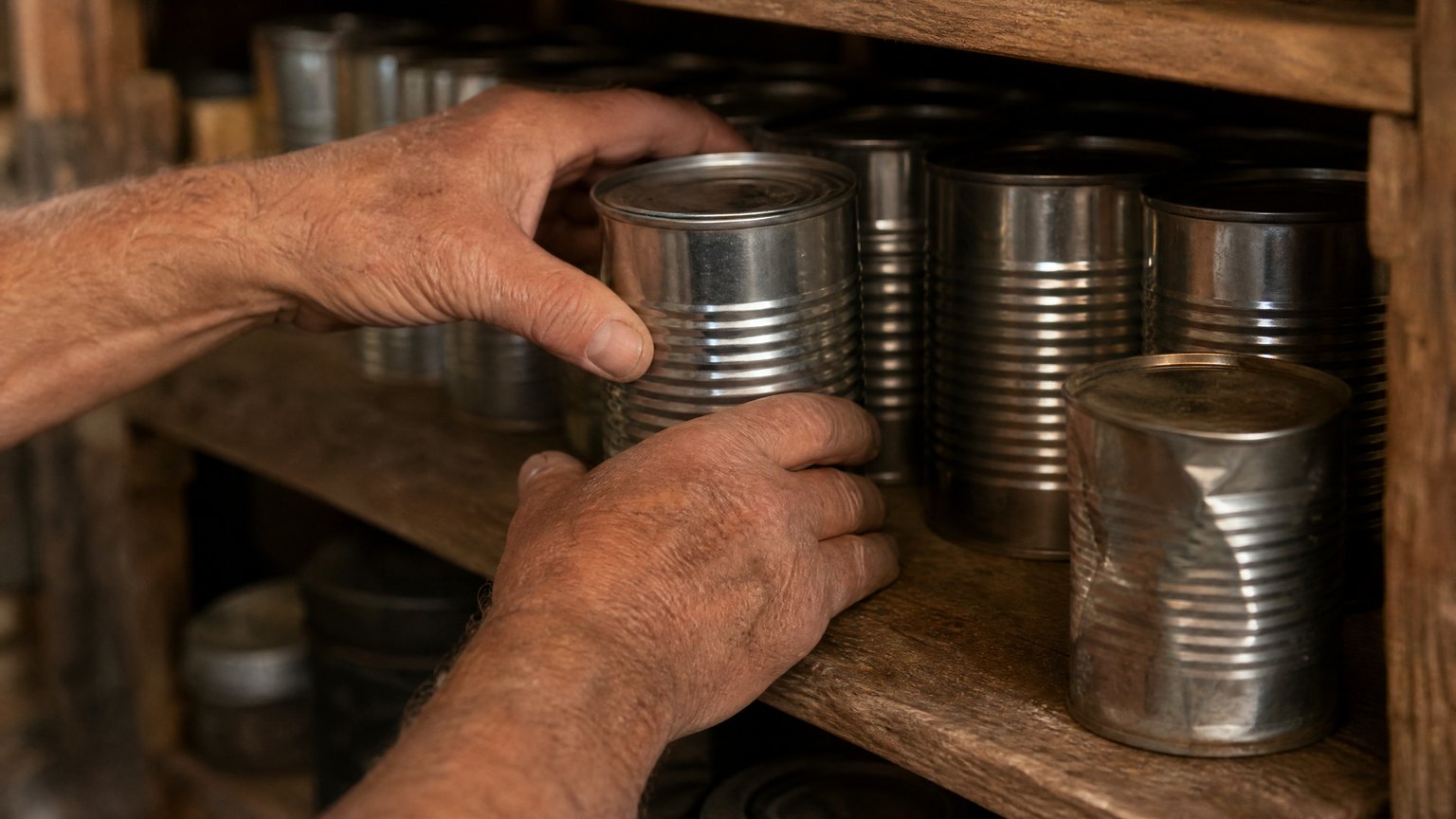
Start with the one that reverses most people's intuition. Per FSIS, high-acid canned foods such as tomatoes and fruits keep their best quality for 12 to 18 months, while low-acid canned foods such as meats and vegetables keep for two to five years. The acidic food expires sooner, not later. FSIS explains the mechanism too: in high-acid foods like canned tomatoes, natural chemicals in the food continually react with the container, and over several years this can cause taste and texture changes and eventually lower the nutritional value.
Those are quality windows rather than safety windows, and the distinction matters. Extension's position, stated for emergency storage specifically, is that commercially canned foods in metal or glass will remain safe to consume as long as the seal has not been broken, immediately followed by the qualifier that this is not to say the quality will be retained for that long. FSIS pushes back on the "cans last forever" version of the same idea, noting there are still limits to how long a can will preserve food, and pointing at rust, corrosion and dents. Safe and good are two separate questions, and a very old can can pass one and fail the other.
On damage, FSIS draws a specific line that a lot of advice flattens into "throw out any dented can." What it actually says is that if a can containing food has a small dent but is otherwise in good shape, the food should be safe to eat, and that you should discard deeply dented cans. Its test for "deep" is physical and easy to remember: a deep dent is one that you can lay your finger into. It adds that a sharp dent on either the top or side seam can damage the seam and allow bacteria to enter the can. Rust gets the same graded treatment. Surface rust that you can remove by rubbing with your finger or a paper towel is not serious, and FSIS says you can keep those cans. The buying rule is stricter than the keeping rule: do not purchase bulging, rusted, leaking, or deeply dented cans in the first place.
One context switch worth knowing. After a disaster, the guidance tightens. Ready.gov's post-emergency list tells you not to eat food from cans that are swollen, dented or corroded, without the finger test. That is a stricter rule for a situation where you cannot know what a can has been through. Use the graded FSIS version for your ordinary pantry and the strict version after a flood or a fire.
Home canning deserves its own paragraph, because it is the highest-stakes thing in this article. The CDC states that home-canned vegetables, which are low-acid foods, are the most common cause of botulism outbreaks in the United States. Its method rule is not a preference: pressure canning is the only recommended method for canning low-acid foods, and a boiling water canner should not be used for low-acid foods because it will not protect against botulism. The CDC also rules out a shortcut people reach for, saying not to use an electric multi-cooker appliance even if it has a canning or steam canning button on the front panel. For storage it gives 50 to 70 degrees for best quality and, for safety, do not store above 95 degrees.
The CDC's line that should govern how you handle a doubtful jar: you cannot see, smell, or taste the toxin that causes botulism. There is no sniff test.
Throw out food if the container is leaking, bulging, or swollen; if it looks damaged, cracked, or abnormal; if it spurts liquid or foam when opened; or if the food inside is discolored, moldy, or smells bad. Any one of those is enough on its own.
Step Six
The Date on the Package Is Not What You Think
This is the highest-value paragraph in the article for most households, because it is where stored food gets thrown away for no reason and where it gets kept for the wrong one.
FSIS's food product dating guidance is unusually plain: except for infant formula, dates are not an indicator of the product's safety and are not required by Federal law. Then it separates the phrases, which do not mean the same thing.
Definitions from the FSIS Food Product Dating page. FSIS attaches an important limit to all of this: if the date passes during home storage, a product should still be safe and wholesome if handled properly, until the time spoilage is evident. That is not the same as safe forever.
There is a reason FSIS pushes on this. USDA estimates that 30 percent of the food supply is lost or wasted at the retail and consumer levels, and misread date labels are a real part of that. If you have ever cleared a storage shelf on the strength of a printed date alone, you have probably thrown out food that was fine.
Rotation is the habit that makes the whole system work, and it is boring on purpose. Extension's rule for canned goods is to always use first-in, first-out, meaning use your oldest cans first, and it recommends labeling the purchase date, month and year, on the can lid with a marker. That one marker habit removes all guesswork later, because the printed code on a can is often not a date you can read. FSIS adds the frequency: check your pantry every few weeks and use canned goods you have had on hand for a while.
One rotation number that gets misapplied. Ready.gov says stored water that you bottled yourself should be replaced every six months. That is a water rule, and it does not transfer to food. There is no six-month food rotation standard, and applying one to a bucket of rice would defeat the purpose of buying it.
Step Seven
When the Power Goes Out or the Water Comes In
Storage plans get tested by exactly two events, and they have different rules. One is a temperature problem. The other is a contamination problem, and contamination is much less forgiving.
For an outage, FoodSafety.gov gives the timings worth memorizing. A refrigerator will keep food cold for about four hours if you leave the door closed. A full freezer holds its temperature for approximately 48 hours, or 24 hours if it is half full, again with the door closed. Discard perishable food that has been above 40 degrees for two hours or more, and cut that to one hour if the temperature is above 90 degrees. On the question everyone asks, the test is physical rather than temporal: if the food still contains ice crystals or is 40 degrees or below, it is safe to refreeze or cook. Our own walkthrough of the wider version of this is in how to prepare for a power outage.
Flooding is the harsher case, and the headline rule admits no exceptions. FoodSafety.gov says not to eat any food that may have come into contact with flood or storm water. Its discard list is more aggressive than most people expect, and the reason is that "sealed" and "waterproof" are not the same thing. Throw out food in packages that are not waterproof. Throw out food in cardboard containers, including juice, milk and baby formula boxes. Throw out food containers with screw-caps, snap-lids, crimped caps, twist caps, flip tops, and snap tops, all of which look fine and are not sealed against contaminated water. Throw out home-canned foods, because they cannot be disinfected. And throw out any can or container that is bulging, opened, or damaged.
What can be saved is commercially prepared food in cans and in metal or plastic pouches, and only by following the whole procedure. The order is load-bearing here, since washing before sanitizing is what lets the sanitizer work, and step one is what makes step six necessary.
Procedure as published by FoodSafety.gov for commercially prepared food in cans and metal or plastic pouches. Home-canned food is not on this list and cannot be salvaged this way.
One more failure mode that catches people who store food in a garage, shed or vehicle. FSIS covers cans that freeze. Discard any swollen can. Discard frozen cans that are not swollen but have been allowed to thaw at 40 degrees or higher, and treat cans that have thawed and refrozen as unsafe. A can that is still frozen solid and undamaged can be thawed in the refrigerator and used, and if it looks or smells abnormal, throw it out. If it seems normal, FSIS says to thoroughly cook the contents right away by boiling for 10 to 20 minutes.
Food is only one column of an outage plan, and the rest of it is worth having written down before you need it. Our friends over at 1st Hour put together a power outage emergency plan covering the medical and household side of the same event.
A Setup You Can Actually Build This Month
None of this needs to happen at once, and a partial system beats a perfect plan you never start. Here is the order that gets the most benefit per weekend.
Look at what that list costs. A thermometer, a pallet, buckets, pouches, absorbers, a marker, and staples that are among the cheapest calories in the store. The technique is worth more than the budget here, which is the opposite of how food storage is usually sold. The same thinking applies to the rest of a kit, whether that is a properly packed bug-out bag, a winter car emergency kit, or knowing how to purify water when the stored gallons run out.
Stored food fails quietly. Nothing announces itself, the bucket looks exactly the same at year one and year ten, and the only way to know is to have controlled the conditions in the first place. Get the temperature right, keep it dry, seal only what belongs sealed, and put a date on every lid. Do that and the shelf will still be there on the day you finally need it, which is the entire job.
Get the Food Storage Field Card as a Printable PDF
One sheet for the pantry wall: the temperature ranges, realistic shelf life by staple, the moisture rule for sealing, the FSIS dent and rust tests, what each date phrase means, and the outage and flood rules. Sized to tape inside a cupboard door.
Download the Field Card (PDF)Stock the Shelf. We'll Handle the Gear.

Every month, TacticalBox members get hand-picked tactical, survival, and outdoor gear, sourced ourselves from makers all over the country and curated to be some of the best equipment on the market, worth $150 or more per box. Subscribe once and the right gear keeps showing up before you need it, backed by a money-back guarantee. Cancel, pause, or skip anytime.
Become a MemberThis content is for informational purposes only and is not a substitute for guidance from a food safety professional or your local Extension service. Shelf-life figures are quality estimates under stated storage conditions, not guarantees, and they change with temperature. Home canning carries a real botulism risk and should be done only using tested, current recipes and methods from an authoritative source. Never taste food to check whether it is safe, since the toxin that causes botulism cannot be seen, smelled, or tasted. When in doubt, throw it out, and follow the instructions of local authorities after a flood, fire, or extended outage.